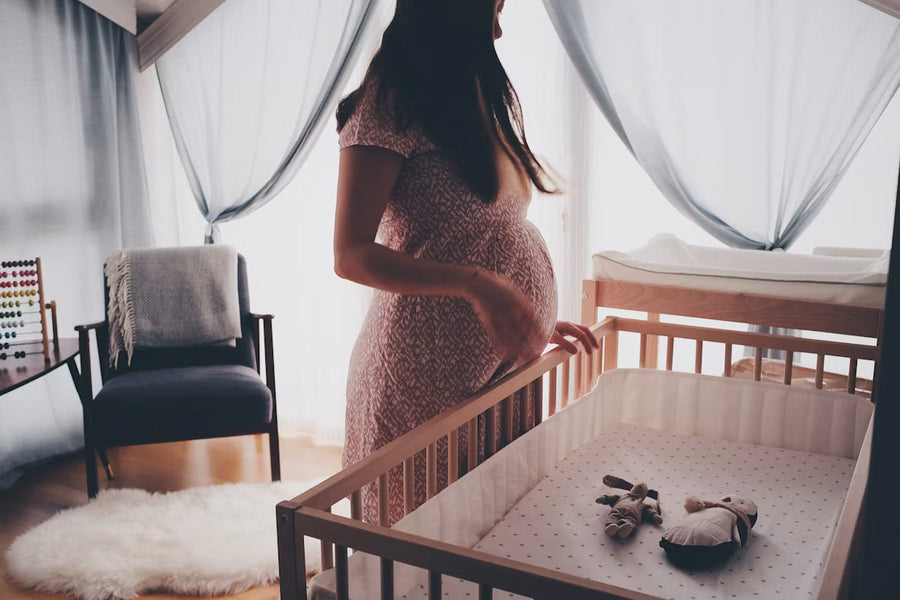
How to Write a Birth Plan That Actually Helps
A birth plan isn't a script — it's a communication tool. What to include, what to leave out, and how...
Read articleI became a mother 6,000 km from my own. The joy, the silence, the daycare guilt — and what the research says about mothers who do it far from family.

In short
I was 24 when I left.
My husband and I made a bold decision, the way you only can at 24: a better future, somewhere else. We didn't think much about what we were leaving behind. We packed. We said goodbye to our parents, our friends, the people we had grown up with, laughed with, cried with. And we got on a plane to a country where I knew no one.
Canada.
I say I knew no one. That's almost true. My mother had some distant relatives here — not close family, people I'd barely heard of — and they helped us settle and get started. I will be grateful to them for the rest of my life. But they weren't mine. They weren't the people who knew my face as a child.
Nobody tells you how long the beginning lasts.
My English wasn't good. So I learned it — fast, because I had to — until I could look for a job. At the same time I was learning a new culture, trying to make friends from nothing, and regularly feeling completely lost, standing in a room not understanding what was happening around me.
Years went by like that. I found a job. I got experience. We saved. We waited until we felt financially steady before we planned for a baby, because when there's no one to fall back on, you build the floor yourself.
And then God blessed us. At 30, I became a mother.
Every mother reading this knows the feeling I'm about to fail to describe. The best thing that has ever happened to me. That magic. It's real.
My mom came. For the first time in her life she left everyone behind to be by my side — on the other side of the ocean, in a country whose language she didn't speak, to watch her daughter start a family far from the one she'd raised.
I was lucky, too. A few of the friends we'd made came to see me in the hospital.
And then — this is the part nobody warns you about — everyone leaves. Not unkindly. They have their own lives, and you have yours. My mother flew home. The friends went back to their jobs. The door closed.
And there you are.
What the research says Lack of social support is one of the strongest and most consistent risk factors for postpartum depression — an umbrella review of 77 meta-analyses ranked it alongside a history of depression and intimate-partner violence, with a relative risk above three. In Canada specifically, immigrant women report postpartum depressive symptoms at roughly twice the rate of Canadian-born women, and the risk is highest in the first years after arrival. The Ontario Mother and Infant Study found that, among immigrant mothers, lack of social support was the strongest predictor. None of this means an immigrant mother will struggle. It means the loneliness isn't weakness. It's a known risk, and it deserves to be named.
Every day was the same routine. Joyful — I want to be clear about that. My baby, my days, my hands learning what to do.
But I couldn't go to my mom's. My mom couldn't drop by. There was an ocean between us. Most days it was me, on my own, in the quiet.
It was harder than I thought it could be. I don't think I said that out loud at the time.
We went home for the summer. I spent most of those days with my mother, my father, the family I'd grown up in. And then the time came to fly back, and start again. That flight home — back to Canada, back to the quiet — is the one I still feel.
In Canada, I had a year. Some parents now have the option of 18 months. I know how lucky that is. I think about mothers in the United States, where there is no national paid leave at all and many go back within weeks, and my heart breaks for them.
But when my year ended, I had to bring my son to daycare and go back to work. That was the hardest part of being a mother, for me. Leaving my precious, tiny baby with strangers.
At the time I had read, and believed, that children should be with their mothers until at least three. My heart was wrenching. I went anyway, because I had to — so that he, and we, could have the future we'd crossed an ocean for.
What the research says I went back to look at this properly, years later. The largest long-term study of early childcare — the US NICHD Study of Early Child Care, which followed over 1,300 children from birth into adolescence — found that family characteristics and the quality of the mother's relationship with her child were much stronger predictors of how children turned out than anything about childcare. Where childcare mattered, quality mattered more than hours, and effects were generally small. Very long hours (40+ per week) combined with low-quality care and low parental sensitivity carried some risk; ordinary hours in decent care, with an engaged parent, did not show the harm I feared. I wish I had known that at the daycare door. It wouldn't have made it easy. It might have made it lighter.
My baby is nine now.
And here is the strange thing: I feel most of the pain now. Now, when the years are behind me, I feel the tiredness of them. The emptiness of them. How I lived them — one woman, one baby, one ocean.
I'm grateful for all of it. For Canada, for the life we built, for the boy who is nine. But I'd be lying if I said living far from everyone is always the best thing. It isn't. It's a trade. You get the future. You pay in the present, and sometimes you don't get the bill until years later.
If you're pregnant in a country where nobody knows your name, here is what I would say to you.
Tell one person how hard it is. I didn't. I performed fine. Say it to your partner, a friend, a nurse, your doctor at the postnatal visit — anyone. Isolation is the risk, and naming it is the first thing that reduces it.
Ask your care team what's local. In Ontario, public health units run postnatal visits and parent groups; many communities have newcomer and settlement services that include new-parent programs. I didn't know to ask. Ask.
Let the people who show up count. The distant relatives. The one friend who came to the hospital. They aren't your mother. They are still your village. Take what's offered.
Don't wait until you feel financially perfect to accept help you can afford. Whatever you can pay for — a cleaner, a few hours of care, a meal service for the first month — is not indulgence. It's substituting for the grandmother who isn't there.
Know that the daycare door is survivable. Both of you will be okay. The research says so, and my nine-year-old says so.
And know that the ache is normal. It doesn't mean you chose wrong. It means you left something real behind to build something real here. Both are true.
You are not alone in this. There are thousands of us, in kitchens across this country, raising children far from the people who raised us. I'm writing this so one of you reads it at 2 a.m. and knows that.
This article is a personal story, not medical advice. If you are struggling with low mood, anxiety, or feel unable to cope after having a baby, please talk to your doctor, midwife, or public health nurse. If you have thoughts of harming yourself, contact emergency services now.
A birth plan isn't a script — it's a communication tool. What to include, what to leave out, and how...
Read article
Exhausted, nauseous and weepy in early pregnancy? Here's what's normal in the first 12 weeks, what isn't, and how to...
Read article
The 12 weeks after birth, honestly — bleeding, stitches, the baby blues, and the warning signs that mean "call now."...
Read article